



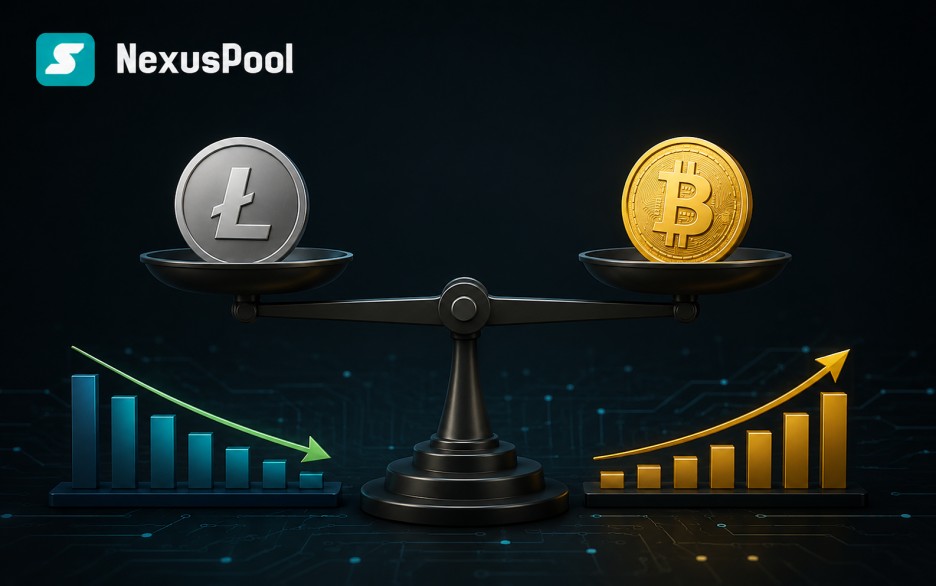
People choosing which chain to solo mine often frame it as a values question: which project do I believe in, which community do I want to support, which coin’s philosophy matches mine. Those are legitimate personal considerations. But there’s a separate, much more mechanical question underneath all of them that determines your actual odds, and it’s worth separating the two clearly.
The mechanical question: difficulty relative to your hashrate
Every proof-of-work chain has its own current difficulty, driven by its own total network hashrate. Your odds of finding a block on any given chain, with a fixed amount of your own hashrate, are set entirely by that chain’s difficulty. A chain with dramatically less total network hashrate than Bitcoin has a correspondingly lower difficulty, which means the same hardware finds blocks on it far more often in expectation, purely as a function of that smaller denominator. This is true regardless of the chain’s price, its community, or its long-term prospects. It’s pure arithmetic.
Why smaller difficulty isn’t automatically “better”
A shorter expected wait doesn’t mean a better outcome, because the reward on a lower-difficulty chain is also generally smaller in market value than Bitcoin’s. The actual expected value calculation involves both sides: probability and payout size, not probability alone. A chain that’s a thousand times easier to find a block on but pays a reward worth a thousandth as much isn’t a better bet in expectation, it’s roughly the same bet with different variance characteristics: more frequent, smaller wins instead of rarer, larger ones.
What actually differs meaningfully between chains
Where chain choice genuinely matters beyond the raw math is variance tolerance and psychological experience. A miner running Bitcoin solo at small scale may go a very long time, plausibly longer than their hardware’s useful life, without finding anything. The same miner running a lower-difficulty chain will likely see more frequent, smaller confirmations that a hash was found and credited correctly, which some people genuinely value as feedback that the system is working, distinct from the dollar value of what was found.
The hardware constraint underneath it all
Chain choice is also constrained by hardware, since Bitcoin’s SHA-256 and Litecoin/Dogecoin’s Scrypt require entirely different silicon. This means the real decision, for someone who already owns hardware, is usually not “which chain philosophically appeals to me” but “which chains does the hardware I already have actually support,” followed by the difficulty and variance tradeoffs among those options.
A more honest way to frame the choice
Rather than asking which chain you believe in most, it’s worth asking directly: what hardware do I have or want to buy, what variance am I comfortable with, and given those two answers, which specific chain’s current difficulty produces odds I’m content to accept. That framing produces a decision you can actually stand behind later, independent of how the outcome turns out.
A caveat about liquidity and practicality
Difficulty and expected value aren’t the only practical factors. A chain with very low network hashrate can also mean thinner liquidity for the reward once found, and a smaller, less battle-tested codebase underneath the chain itself. Those are real considerations worth weighing alongside the raw odds math, not reasons to ignore it, but reasons not to treat difficulty as the only variable that matters in an absolute sense.
NexusPool supports solo mining across multiple chains with their real, current difficulty displayed plainly, so this comparison can be made with actual numbers rather than assumptions. A rig can point at whichever chain the numbers favor, then repoint later, without setting up a new account each time on NexusPool’s home page. Free, non-custodial software, not an investment, and no chain choice guarantees a reward.
Trust nothing. Verify a chain’s current real difficulty yourself before deciding where to point your hardware.
About NexusPool: NexusPool is free, non-custodial mining software that lets a miner solo mine whichever supported chain its current difficulty favors, instead of committing to one chain out of habit. A live look at those chains and their difficulty sits on NexusPool’s live chain overview.